P What SANDR does

AI-native hospitality management that acts on what the floor is telling you.

SANDR gives managers one conversation where the operation is read and the work gets done: the signal recorded, the task written into the plan, the schedule laid in dependency order, the fix checked after service. Built for the small misses that become expensive when nobody carries them forward.

A limited number of separately scoped, paid operator pilots are available while the product is in early access.

The operating problem

Great hospitality needs more than heroic saves.

The expensive problems usually start small: a prep miss, a rushed handover, a weak reset, then the same pressure again tomorrow.

A manager needs more than “What happened?”

What is the evidence really pointing at?

What should be fixed first?

What is creating the most pressure on the team?

What keeps repeating across shifts or locations?

The partner

A partner who knows the operation around the question.

A generic chat box can sound confident and still know nothing about last Friday, the late prep, the manager note, or the fix that actually helped in Venue B.

SANDR works inside your workspace: venue history, live plans and their dependencies, signals and how they have moved, files, reports, past conversations, and what you have told her to remember.

And she does not stop at the answer. Ask “What do we do about no-shows?” and the reply starts with what this team has already seen and tried — and can end with the response written into the venue’s plan, in the same conversation.

Mid-discussion about turnover, she can find the right signal, log it with your permission, and add the fix to the plan, reason attached.

HW How it works

From “something feels off” to a fix the team can trust.

The first warning is often a feeling: service is dragging, prep is thin, handover feels messy, the same complaint is back again. Operator judgment stays at the center while SANDR connects that read to evidence, plans, tasks, proof, outcomes, and memory in one operating loop.

01

It reads what is happening

01

It reads what is happening

SANDR brings together check-ins, notes, team updates, task state, proof gaps, venue context, files, reports, and signal history.

Night Shift reads the day’s evidence, live plans, and signal movement so Today can open with real heads-ups instead of dashboard archaeology.

02

It names the real problem

The visible symptom may be staff turnover, new people staying unsure for weeks, or an owner who has to be on the floor to keep standards intact.

The deeper pattern may be onboarding without one shared sequence, different trainers teaching different versions, and daily interventions replacing structure.

03

It connects the issue to the right response

SANDR connects the problem to response blocks, entry conditions, proof requirements, playbooks, and previous work that actually helped.

“Train them better” becomes a shared path: role basics, observed practice, clear ownership, manager checks, and proof.

04

It writes the working sequence

Ask SANDR to schedule a task or whole plan and she writes the dates in dependency order: foundations first, dependent work after its blockers.

Role basics, shadow work, and supervised practice come before independent assessment. Owners and priorities remain the operator’s call.

05

It keeps proof attached to the work

Plans and tasks carry proof requirements: a photo, confirmation, or manager sign-off—an agreed signal from the work, not a checkbox.

For onboarding, proof can show that role basics and supervised practice happened consistently, regardless of who trained the new starter.

06

It records whether anything changed

The original issue stays connected to the action, so the team can record whether new people became confident, standards held without the owner present, and repeated corrections reduced.

The fix remains tied to the structural problem it was meant to change.

07

It turns outcomes into shift memory

When a fix works, outcomes feed learning records so the onboarding sequence or management structure is easier to reach next time.

New managers inherit why the process changed, where starters used to get lost, and what helped standards survive without constant owner intervention.

The product areas

Organised by the job, not an arbitrary screen count.

01

Run the operation

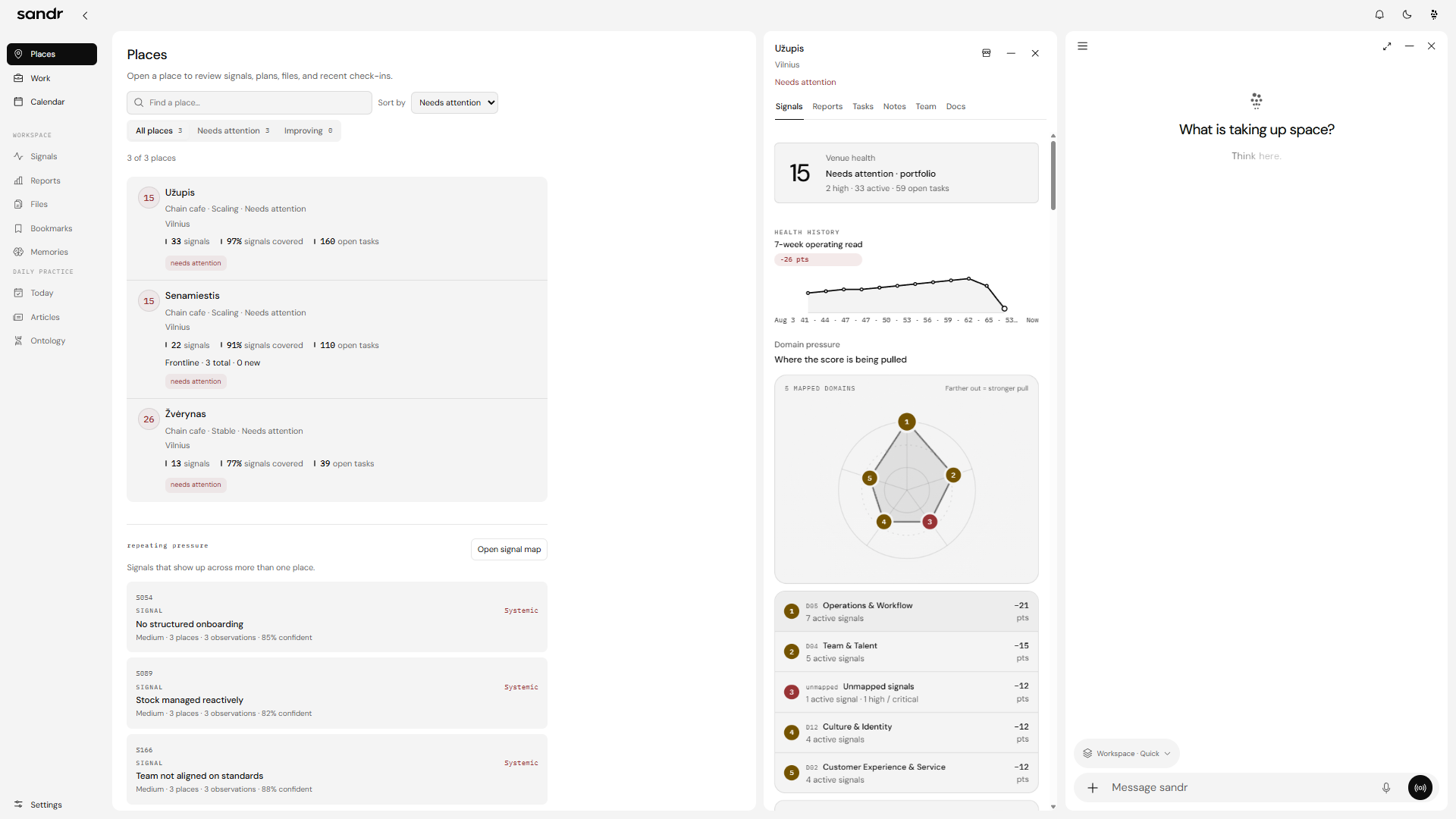
Places

Compare venue health and weekly movement, then open one location for signals, new and total Frontline activity, reports, tasks, notes, files, and structured Check-ins.

See Places

sandr

Ask in ordinary language with the active venue, screen, files, reports, plans, conversations, and approved memory available as context. Voice input is available when enabled.

See the conversation

Work

Turn signals into plans and dependency-aware tasks with owners, dates, priorities, blockers, comments, proof requirements, and outcome checks.

See Work
02

Read the day and the group

Today

Open a briefing built from current workspace activity: heads-ups, decisions, evidence, and work that needs attention. Scheduled generation depends on the pilot configuration; otherwise it is prepared when Today opens.

See Today

Signal Matrix & movement

Move between What’s moving, the detailed Signal Matrix, and venue radars to read recent change, coverage, heat, and cross-place patterns over time. Projected views are labelled rather than presented as observed fact.

See the matrix

Reports & Files

Keep generated diagnosis, uploaded evidence, extracted document text, and image descriptions searchable and attached to the venue context. Extraction is best-effort.

See evidence
03

Include people and knowledge

Frontline

A separate, role-scoped experience for private reflection, approved sharing, manager response, and Growth. Raw private conversations are not shown to managers.

See Frontline

Articles & Ontology

Explore the operating logic behind signals, response blocks, tools, and recommendations. The library supports judgment; it does not replace venue evidence.

Open the library

Inside the workspace

The question moves. Its history stays attached.

Five real product states from one synthetic workspace. No customer records—just the evidence, memory, judgment, work, and growth behind one operating picture.

North Cafe reports and supporting files attached to the venue
01

Venue evidence

Reports and source files stay attached to the place they describe.

Venue evidence, screen 1 of 5

Not more information

SANDR is designed to help teams leave firefighting mode.

Reduce repeated problems without adding another reporting ritual.

Make service, coordination, and standards easier to understand and act on.

Keep the floor signal, response, proof, and memory connected when pressure returns.

Walkthrough

Bring one service problem your team already knows.

We will map how SANDR reads it, writes the response into a plan, and checks whether the fix actually held.